Onward and onwards both mean moving forward in time or direction from a certain point. They have the same meaning.
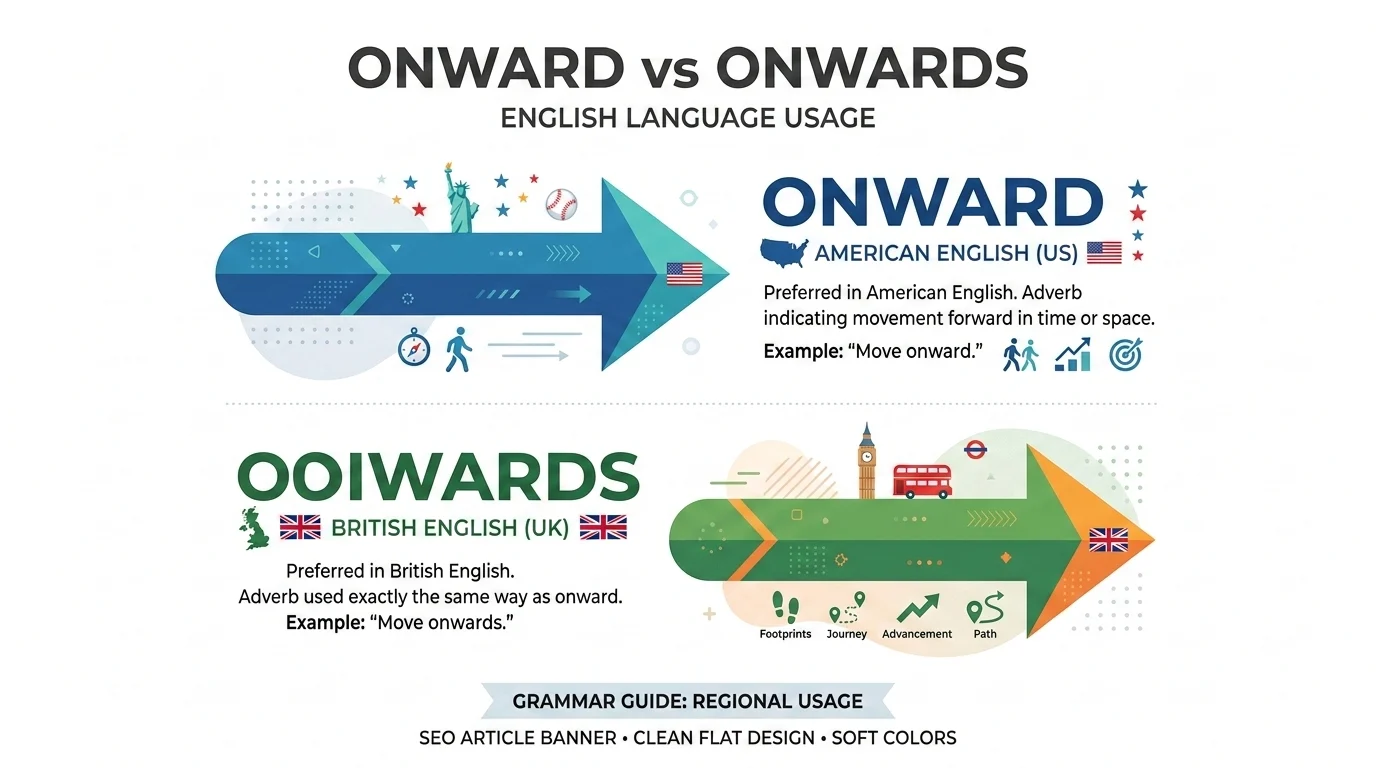
The main difference is spelling style.
- Onward is more common in American English.
- Onwards is more common in British English.
Both can be used as adverbs and sometimes adjectives.
Examples:
- The meeting will continue from 2 PM onward.
- The road remains closed from Monday onwards.
- The team moved onward after the break.
- From that day onwards, everything changed.
In most situations, choosing one depends on the English style you follow.
Many English learners and even native speakers often feel confused about onward vs onwards. Both words appear in books, emails, and everyday speech. Sometimes you see from Monday onward, while other times it says from Monday onwards. This makes people wonder if one spelling is correct and the other is wrong.
The truth is simpler than it looks. Both forms are correct, but they are used in slightly different regions and styles of English. Because English changes across countries like the United States and the United Kingdom, small spelling variations often appear.
People search for onward vs onwards to understand which version they should use in writing, school assignments, professional emails, or blog posts. This guide explains the meaning, history, grammar, and real-life usage of both forms in clear and simple language so you can use them with confidence.
The Origin of Onward vs Onwards
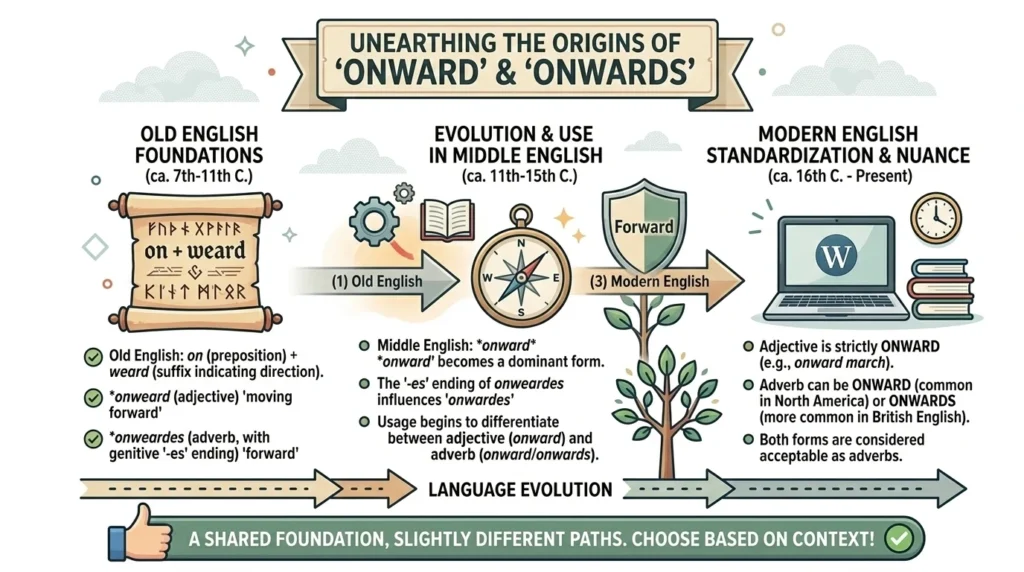
The word onward comes from Old English. It combines two parts:
- on meaning forward or ahead
- -ward meaning direction
Together, they created a word that meant moving forward in direction or time.
Over time, English speakers added the -s ending to many adverbs. This is why we also see words like:
- towards
- backwards
- afterwards
- forwards
The same pattern created onwards.
In early English writing, both forms appeared. Writers used them almost interchangeably. As English spread across countries, spelling habits started to differ.
American English gradually preferred the shorter form onward, while British English continued using onwards more often.
Despite the difference, the meaning has remained the same for centuries.
British English vs American English Spelling
English spelling changes slightly depending on the region. This also affects the use of onward and onwards.
American English usually prefers shorter adverb forms without -s. British English often keeps the -s ending.
Examples of similar patterns include:
| American English | British English |
|---|---|
| toward | towards |
| forward | forwards |
| afterward | afterwards |
| backward | backwards |
| onward | onwards |
Example sentences:
American style
- The program starts from 10 AM onward.
British style
- The program starts from 10 AM onwards.
Both sentences mean exactly the same thing.
The difference is mostly about regional preference rather than grammar rules.
Reciept Vs Receipt: The Simple Trick To Remember 💡
Which Spelling Should You Use?
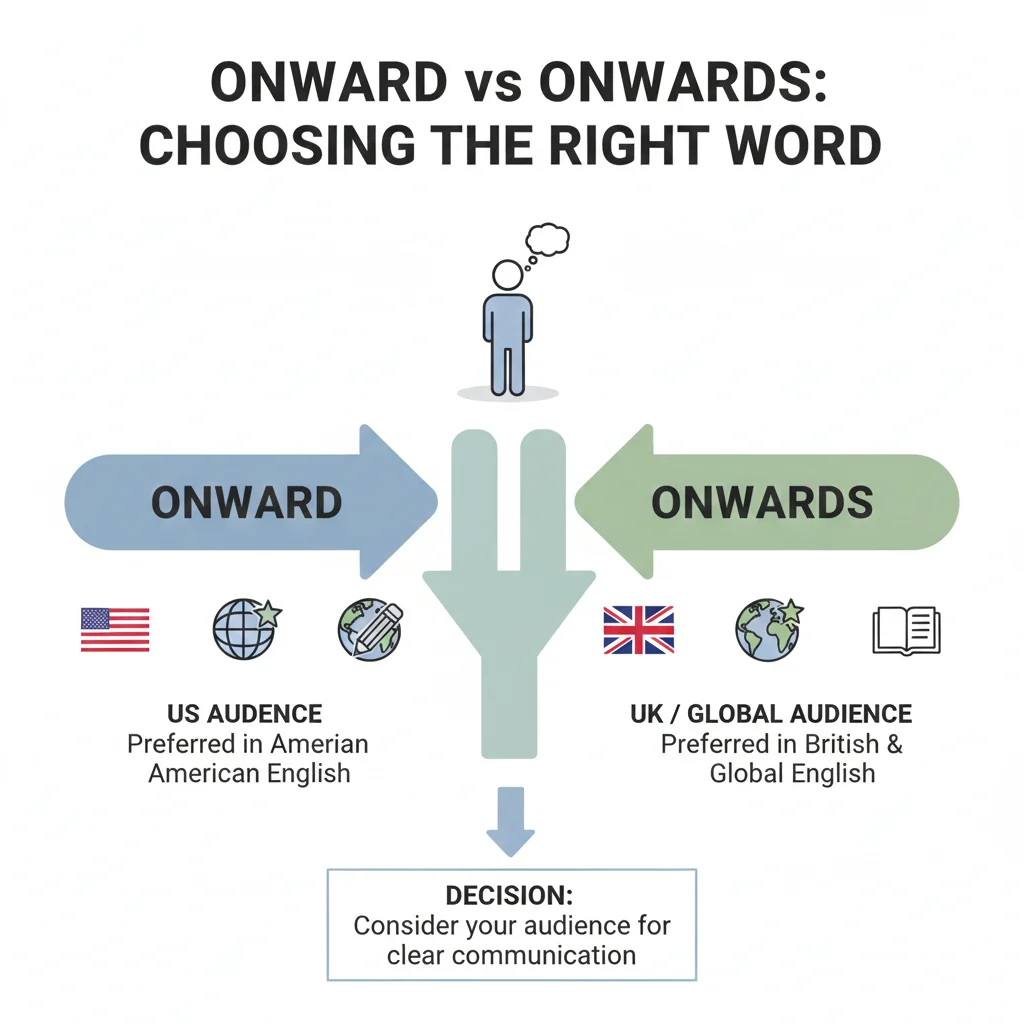
Choosing between onward and onwards depends on your audience.
If you write for American readers
Use onward.
It matches American spelling standards and sounds more natural in US writing.
Example
- Sales will increase from this month onward.
If you write for British or Commonwealth readers
Use onwards.
Example
- Classes run from 4 PM onwards.
If your audience is global
Either spelling works. The key rule is consistency.
Pick one style and keep it the same throughout your article, email, or document.
For example, if you write:
- From Monday onward
Do not later write:
- From Friday onwards
Consistency improves clarity and professionalism.
Common Mistakes with Onward vs Onwards
Even though both words are simple, people often make small mistakes.
Mistake 1: Thinking one spelling is wrong
Incorrect belief
- Only onward is correct.
Reality
Both forms are correct.
Correct examples
- The offer runs from today onward.
- The offer runs from today onwards.
Mistake 2: Mixing styles in the same text
Incorrect
- The service will operate from Monday onward and continue from Tuesday onwards.
Better
Choose one style and stay consistent.
Correct
- The service will operate from Monday onward and continue from Tuesday onward.
Mistake 3: Using it incorrectly with time
Incorrect
- The meeting begins onward.
Correct
- The meeting begins from 10 AM onward.
Mistake 4: Confusing meaning
Incorrect
- We walked onward of the building.
Correct
- We walked onward past the building.
Onward vs Onwards in Everyday Examples
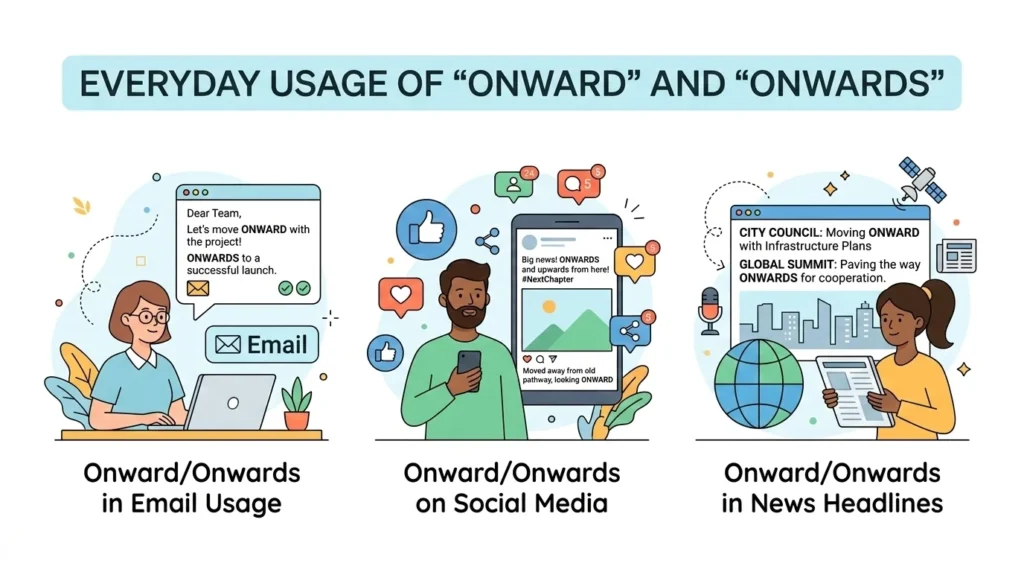
Both forms appear in daily communication. Here are common situations where people use them.
- Our office hours will change from next week onward.
Workplace message
- All employees must follow the new policy from Monday onwards.
News style
- Prices are expected to rise from April onward.
Social media
- New videos will be uploaded from today onwards.
Formal writing
- The rule applies from the year 2026 onward.
Time expressions
Examples people often search for include:
- Is it 12 pm onwards or onward?
Both are correct.
Examples
- The shop is open from 12 PM onward.
- The shop is open from 12 PM onwards.
Other examples:
- The event begins from 4 PM onward.
- The event begins from 4 PM onwards.
- Classes continue from 10 AM onward.
Onward vs Onwards – Google Trends & Usage Data
Search data shows that both spellings are widely used around the world. However, usage patterns vary by region.
United States
The form onward appears more often in newspapers, academic writing, and websites.
United Kingdom and Commonwealth countries
The form onwards appears more frequently in news articles and everyday writing.
Countries where onwards is common include:
- United Kingdom
- Australia
- India
- New Zealand
Countries where onward dominates include:
- United States
- Canada (often mixed usage)
Internet search queries also show many people asking about time expressions like:
- From this week onward or onwards
- From 2 PM onward or onwards
- 4 PM onwards or onward
- 10 AM onward or onwards
This shows that the main confusion is not meaning, but spelling style.
Cumming Vs Cuming: The Secret Difference Explained 🤯
Comparison Table: Onward vs Onwards
| Feature | Onward | Onwards |
|---|---|---|
| Meaning | Moving forward in time or direction | Moving forward in time or direction |
| English style | American English | British English |
| Usage frequency | Higher in US writing | Higher in UK writing |
| Grammar role | Adverb / adjective | Adverb |
| Example | From 2 PM onward | From 2 PM onwards |
| Correctness | Correct | Correct |
Both words function the same in sentences.
FAQs
Which is correct onward or onwards?
Both are correct. The difference depends on regional English. American English prefers onward, while British English prefers onwards.
Is it 12 pm onwards or onward?
Both are grammatically correct.
Examples
- The store opens from 12 PM onward.
- The store opens from 12 PM onwards.
What does onward mean?
Onward means continuing forward in time or direction from a specific point.
Example
- From that day onward, she focused on her goals.
Is it from this week onward or onwards?
Both forms are correct.
Examples
- The rule applies from this week onward.
- The rule applies from this week onwards.
From 2pm onwards or onward?
Both are acceptable.
Example
- The doctor is available from 2 PM onward.
- The doctor is available from 2 PM onwards.
Onward vs onwards grammar difference
There is no grammar difference. The only difference is regional spelling preference.
Can onward be used in formal writing?
Yes. Onward works well in formal writing, academic work, and professional emails.
Conclusion
Understanding onward vs onwards is easier than it first appears. Both words have the same meaning and are grammatically correct. They describe movement forward in time or direction from a specific point.
The main difference lies in regional spelling. American English usually prefers onward, while British English and many Commonwealth countries use onwards more often. This pattern follows the same rule seen in words like toward and towards or backward and backwards.
When deciding which form to use, the most important thing is your audience. If you are writing for readers in the United States, the shorter form onward is usually the best choice. If your audience is in the United Kingdom or other Commonwealth countries, onwards may feel more natural.
For global writing such as blogs, websites, or online content, either spelling works well. Just remember to stay consistent throughout your writing.
Once you understand this simple rule, using onward or onwards becomes easy. Both forms will clearly communicate the idea of continuing forward in time, progress, or direction.

Stella Gibbons is a writer at Pray Ocean, sharing clear English word meanings and meaningful prayer articles for daily guidance.