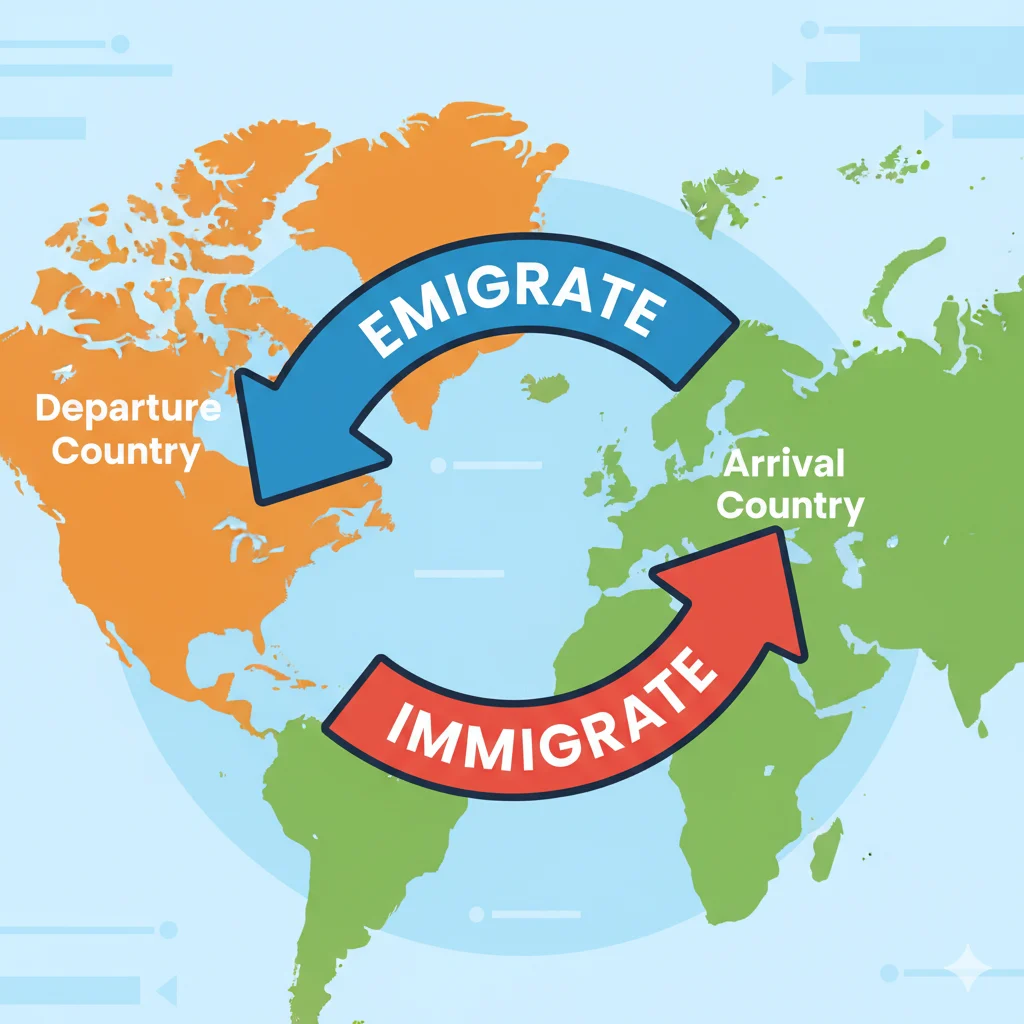
The difference between emigrate vs immigrate depends on perspective.
- Emigrate means to leave your home country to live in another country.
- Immigrate means to enter and settle in a new country.
Both words describe the same move but from different viewpoints.
Examples
- She emigrated from Pakistan to Canada.
- She immigrated to Canada from Pakistan.
Another example:
- Many families emigrate from their homeland for better opportunities.
- Those families immigrate to a new country to start a new life.
Think of it this way:
- E = Exit (emigrate means leaving)
- I = In (immigrate means entering)
This simple trick helps many learners remember the difference quickly.
Many people get confused about emigrate vs immigrate. The words look similar, sound similar, and both relate to moving from one country to another. Because of this, writers, students, and even professionals often mix them up.
If you have ever wondered whether someone emigrates to America or immigrates to America, you are not alone. This confusion appears in emails, news articles, social media posts, and everyday conversations. People also search questions like what is emigrate vs immigrate, when to use emigrate vs immigrate, and emigrate vs immigrate meaning.
Understanding the difference is actually simple once you know the perspective of each word. One focuses on leaving a country, while the other focuses on entering a new one.
In this guide, you will learn the clear difference, correct usage, examples, pronunciation tips, and common mistakes. By the end, you will know exactly when to use each word with confidence.
The Origin of emigrate vs immigrate
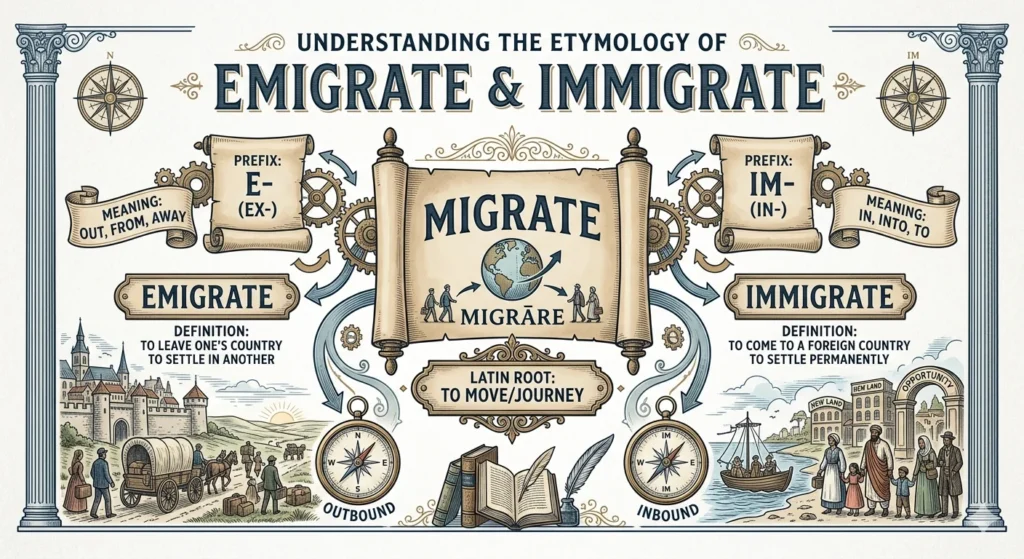
The words emigrate and immigrate come from Latin roots.
Both are built from the base word migrate, which means to move from one place to another. The prefixes change the direction of the movement.
Emigrate
The word emigrate comes from the Latin word emigrare, which means to move away or to depart.
The prefix e- or ex- means out of.
So emigrate literally means to move out of a country.
Immigrate
The word immigrate comes from the Latin immigrare, meaning to move into.
The prefix im- means into.
So immigrate literally means to move into a new country.
This is why the two words describe the same journey but from opposite sides.
For example:
- From the home country’s perspective, a person emigrates.
- From the new country’s perspective, the same person immigrates.
This linguistic structure also explains why people often compare immigrate vs emigrate vs migrate. The root word migrate simply means moving without specifying direction.
British English vs American English Spelling
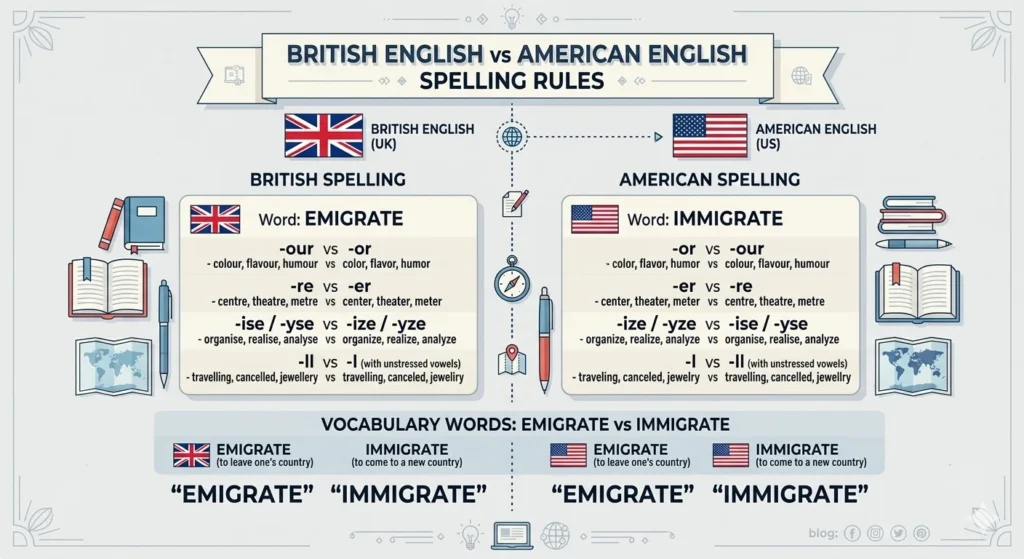
Unlike many English words, emigrate vs immigrate do not change spelling between British English and American English.
Both versions of English use the same spelling and meaning.
However, usage patterns can differ slightly depending on the region and context.
For example, news media in the United States often uses immigration when discussing people entering the country. Meanwhile, international reports may use emigration when discussing people leaving their homeland.
Comparison Table
| Word | Meaning | Example Sentence |
|---|---|---|
| emigrate | leave your country to live elsewhere | Many workers emigrate for better jobs. |
| immigrate | enter another country to live there | Many people immigrate to Canada each year. |
| migrate | move from one place to another | Birds migrate during winter. |
Both British and American writers follow the same spelling rules.
This is different from spelling pairs like color vs colour or center vs centre, where regional spelling changes occur.
Onward Vs Onwards: Which One Is Actually Correct? 🤔
Which Spelling Should You Use?
Choosing between the two words depends on the direction of movement.
Use emigrate when focusing on the country someone is leaving.
Example:
- Thousands of citizens emigrate from their country every year.
Use immigrate when focusing on the country someone is entering.
Example:
- Many people immigrate to the United States each year.
So if someone asks:
Do you immigrate or emigrate to America?
The correct answer is:
- You emigrate from your home country.
- You immigrate to America.
For global writing, this rule stays the same whether your audience is in the US, UK, Canada, or Australia.
Understanding this perspective rule is the easiest way to choose correctly.
Common Mistakes with emigrate vs immigrate
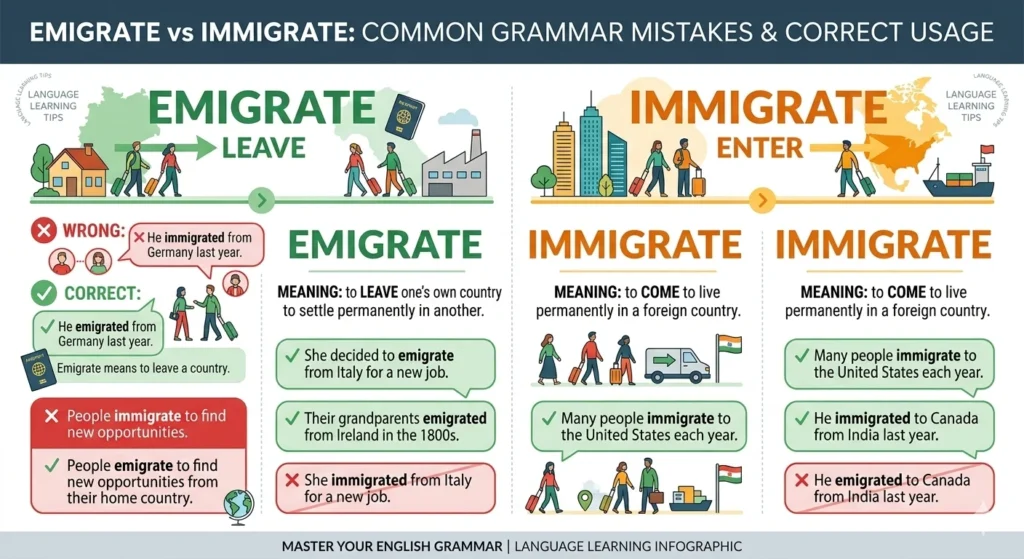
Many writers confuse the two words because they describe the same movement.
Here are some common mistakes.
Mistake 1
Incorrect:
He immigrated from India.
Correct:
He emigrated from India.
Why? Because he left India.
Mistake 2
Incorrect:
She emigrated to Canada.
Correct:
She immigrated to Canada.
Why? Because she entered Canada.
Mistake 3
Mixing migrate with the other words.
Example:
Birds migrate south during winter.
People emigrate from their homeland.
People immigrate to a new country.
Animals usually migrate, while humans immigrate or emigrate.
Mistake 4
Confusing immigrant with immigrate.
- Immigrant is a noun (a person).
- Immigrate is a verb (the action).
Example:
Correct:
She decided to immigrate to Australia.
She is now an immigrant.
emigrate vs immigrate in Everyday Examples
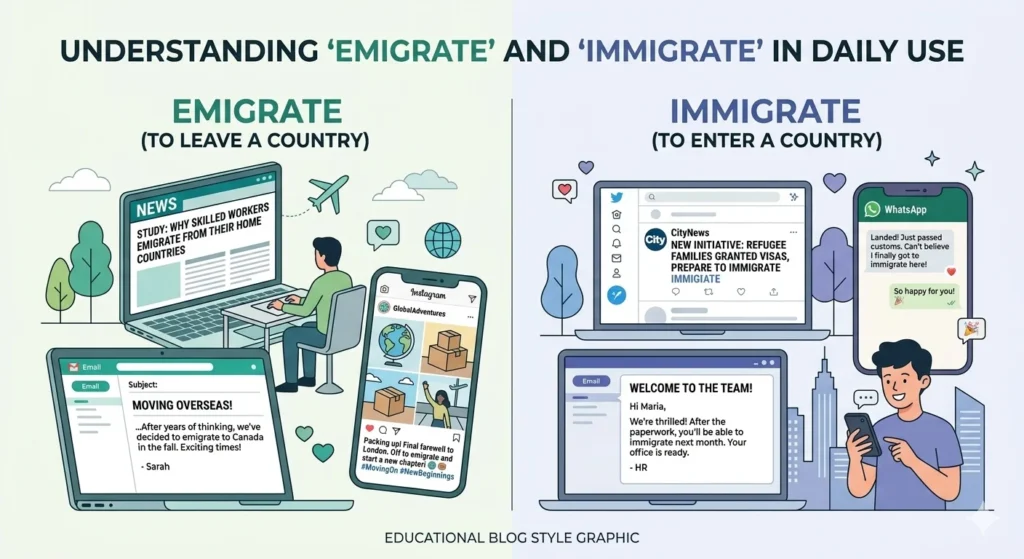
Understanding these words becomes easier with real-world examples.
Email Example
Dear Team,
Many professionals choose to emigrate from their home country for better opportunities. Some later immigrate to Canada or Australia for permanent settlement.
News Example
Thousands of workers emigrate from developing countries each year. Many immigrate to Europe looking for stable jobs.
Social Media Example
“Thinking about whether I should emigrate from my country or try to immigrate to another place for work.”
Formal Writing Example
Economic challenges often encourage citizens to emigrate, while stable economies attract people who wish to immigrate.
Sentence Practice
- My grandparents emigrated from Italy in 1950.
- They later immigrated to the United States.
- Many students hope to immigrate after graduation.
These examples help clarify emigrate vs immigrate in a sentence.
emigrate vs immigrate – Google Trends & Usage Data
Search data shows that many people look up emigrate vs immigrate difference because the words are easy to confuse.
Countries with high search interest often include:
- United States
- Canada
- United Kingdom
- India
- Australia
Students, travelers, and writers frequently search phrases like:
- define emigrate vs immigrate
- when to use emigrate vs immigrate
- emigrate vs immigrate pronunciation
- migrate vs emigrate vs immigrate
Online discussions, including forums and platforms similar to emigrate vs immigrate reddit discussions, often show people debating correct usage.
In general:
- Immigrate appears more often in news headlines about national immigration policies.
- Emigrate appears more in demographic reports about people leaving countries.
This difference reflects the perspective rule explained earlier.
Comparison Table: emigrate vs immigrate vs migrate
| Word | Direction | Example |
|---|---|---|
| emigrate | leaving a country | She emigrated from Brazil. |
| immigrate | entering a country | She immigrated to Canada. |
| migrate | general movement | Birds migrate south. |
This table helps quickly understand emigrate vs immigrate vs migrate.
Aline Vs Align: The Hidden Grammar Mistake ⚠️
FAQs

What does emigrate mean?
Emigrate means leaving your home country to live permanently in another country.
Example:
Many families emigrate for better economic opportunities.
What is the difference between immigration and emigration?
Immigration refers to people entering a country, while emigration refers to people leaving their country.
Both describe the same movement from different viewpoints.
When to use immigrate or emigrate?
Use emigrate when discussing the country someone leaves.
Use immigrate when discussing the country someone enters.
Do you immigrate or emigrate to America?
You emigrate from your home country and immigrate to America.
Both words describe the same move but from different perspectives.
How do you pronounce emigrate and immigrate?
Emigrate pronunciation:
EH-muh-grayt
Immigrate pronunciation:
IH-muh-grayt
The first syllable sound is the main difference.
What is the difference between immigrate vs immigrant?
Immigrate is a verb.
Immigrant is a noun.
Example:
They immigrate to Canada.
They become immigrants.
Are migrate, immigrate, and emigrate the same?
No.
Migrate is general movement.
Emigrate means leaving a country.
Immigrate means entering a new country.
Conclusion

Understanding emigrate vs immigrate becomes simple once you focus on direction. Both words describe the same journey but from different perspectives.
When someone emigrates, they leave their home country to start life somewhere new. When someone immigrates, they arrive in a new country to live there permanently. Remembering the small prefix difference can help avoid confusion. The letter E in emigrate can remind you of exit, while the letter I in immigrate can remind you of in.
These words often appear in discussions about global movement, education, work opportunities, and family relocation. That is why many learners search phrases like emigrate vs immigrate meaning, emigrate vs immigrate examples, and when to use emigrate vs immigrate.
Using the correct term improves clarity in writing, whether in academic papers, news reports, emails, or everyday conversations. It also helps readers quickly understand the direction of movement.
By remembering the perspective rule and practicing with examples, you can confidently use both words correctly in any context.

Ann Quin is a content writer at Pray Ocean, sharing clear English word meanings and heartfelt prayers to guide and inspire readers worldwide.