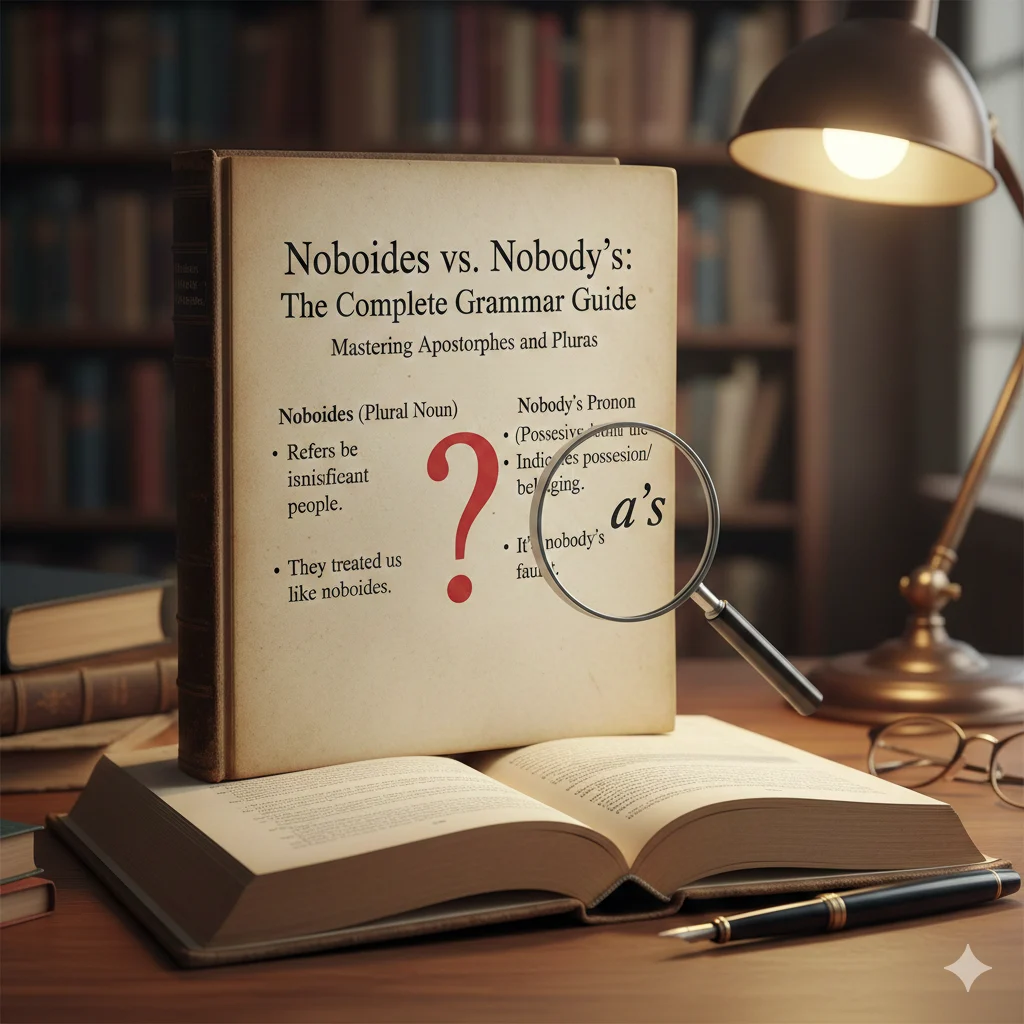
Have you ever stopped mid-sentence and asked yourself: Is it “nobodies” or “nobody’s”? You’re not alone. This small apostrophe can completely change the meaning of your sentence, and many writers, students, and ESL learners struggle with it.
Questions like “Is nobodies a word?”, “Nobody plural or singular?”, and “What’s the difference between nobody’s and nobodies?” are searched thousands of times each month.
Getting it right is essential for emails, blog posts, social media, or formal writing. The wrong form can confuse readers or make your writing appear unprofessional.
In this article, we’ll give you:
- A quick answer to the difference
- Historical origin and grammar rules
- British vs American English usage
- Common mistakes and corrections
- Real-life examples in everyday writing
- Google Trends insights for 2026
- Tables, FAQs, and SEO-friendly internal/external links
By the end, you’ll confidently know when to use nobodies vs nobody’s, avoid mistakes, and improve readability, professionalism, and SEO performance.
Nobodies vs Nobody’s means
Here’s the simplest explanation:
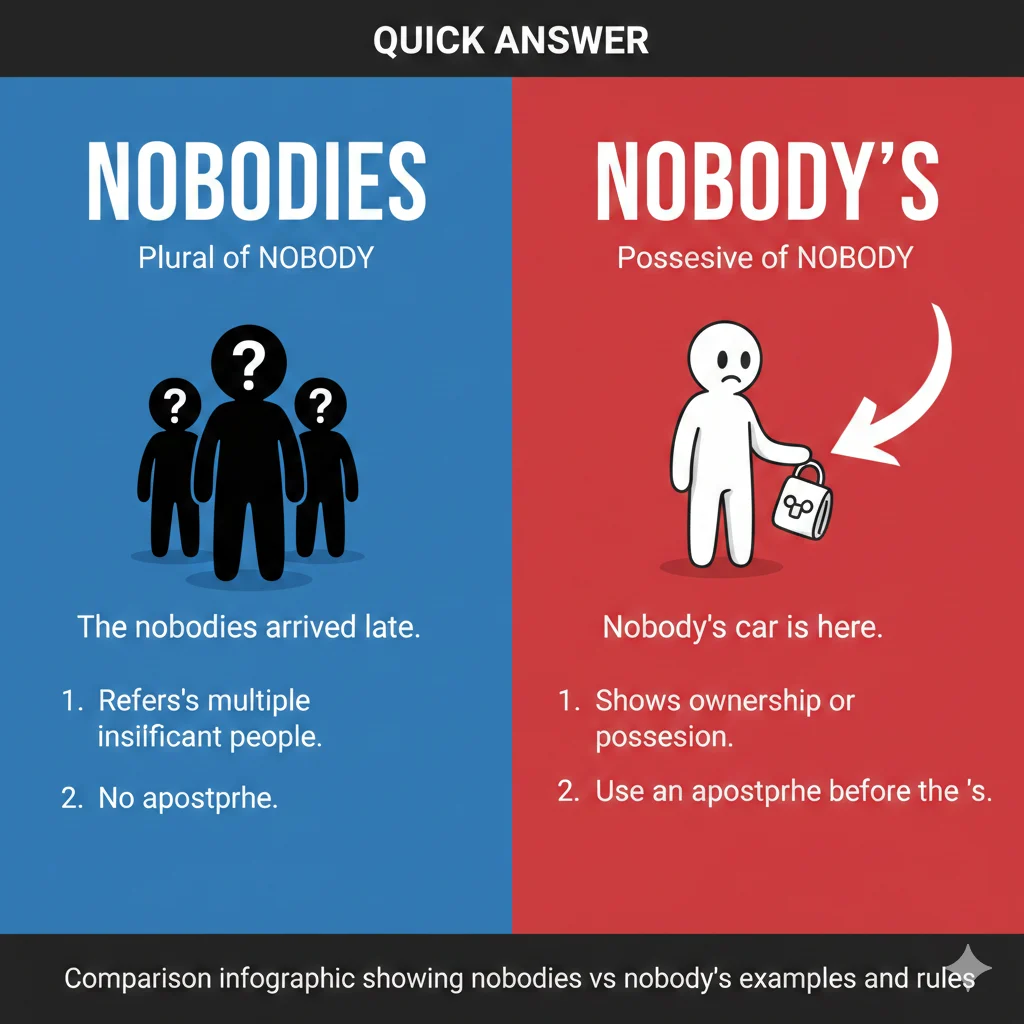
- Nobodies → plural noun for multiple unimportant or unknown people
- Nobody’s → contraction (nobody is/nobody has) or possessive form
Nobodies (Plural Noun)
Yes, nobodies is a word. It refers to multiple unimportant or unknown people.
Examples:
- They started as nobodies but became stars.
- Many students felt like nobodies in the new class.
✅ Use when: talking about more than one unimportant person.
Nobody’s (With Apostrophe)
Nobody’s can be used in two ways:
- Contraction – short for “nobody is” or “nobody has”
- Example: Nobody’s perfect.
- Example: Nobody’s coming to the meeting.
- Possessive – something belongs to nobody
- Example: That pen is nobody’s.
- Example: This problem is nobody’s fault.
Quick Tip: If “nobody is” or “nobody has” works in the sentence, use nobody’s.
The Origin of Nobodies vs Nobody’s
The word nobody comes from Middle English (~14th century), formed by combining no + body, literally meaning not any person.
- Adding -ies → nobodies (plural)
- Adding ’s → nobody’s (contraction/possessive)
Why the confusion exists:
- Apostrophes indicate possession or contraction
- Plurals don’t use apostrophes
Examples:
- ❌ Wrong: Nobody’s are here
- ✅ Correct: Nobodies are here
- ✅ Correct: Nobody’s here
A small apostrophe makes a big difference in meaning.
British English vs American English
Unlike colour/color or favourite/favorite, the spelling of nobodies vs nobody’s does not change.
| Form | Meaning | UK English | US English |
|---|---|---|---|
| Nobodies | Plural noun | Same | Same |
| Nobody’s | Contraction | Same | Same |
| Nobody’s | Possessive | Same | Same |
Tip: Focus on grammar correctness, not regional spelling.
Which Spelling Should You Use?
✅ Nobodies
Use for multiple unimportant or unknown people.
Examples:
- The actors were nobodies before the big film.
- Young writers often feel like nobodies in the beginning.
✅ Nobody’s
Use for contraction (nobody is/nobody has) or possessive.
Examples:
- Nobody’s attending the meeting today.
- That decision was nobody’s responsibility.
Audience Advice:
- 🇺🇸 US → American rules
- 🇬🇧 UK/Commonwealth → British style
- 🌍 Global → Keep simple, clear English
Common Mistakes with Nobodies vs Nobody’s
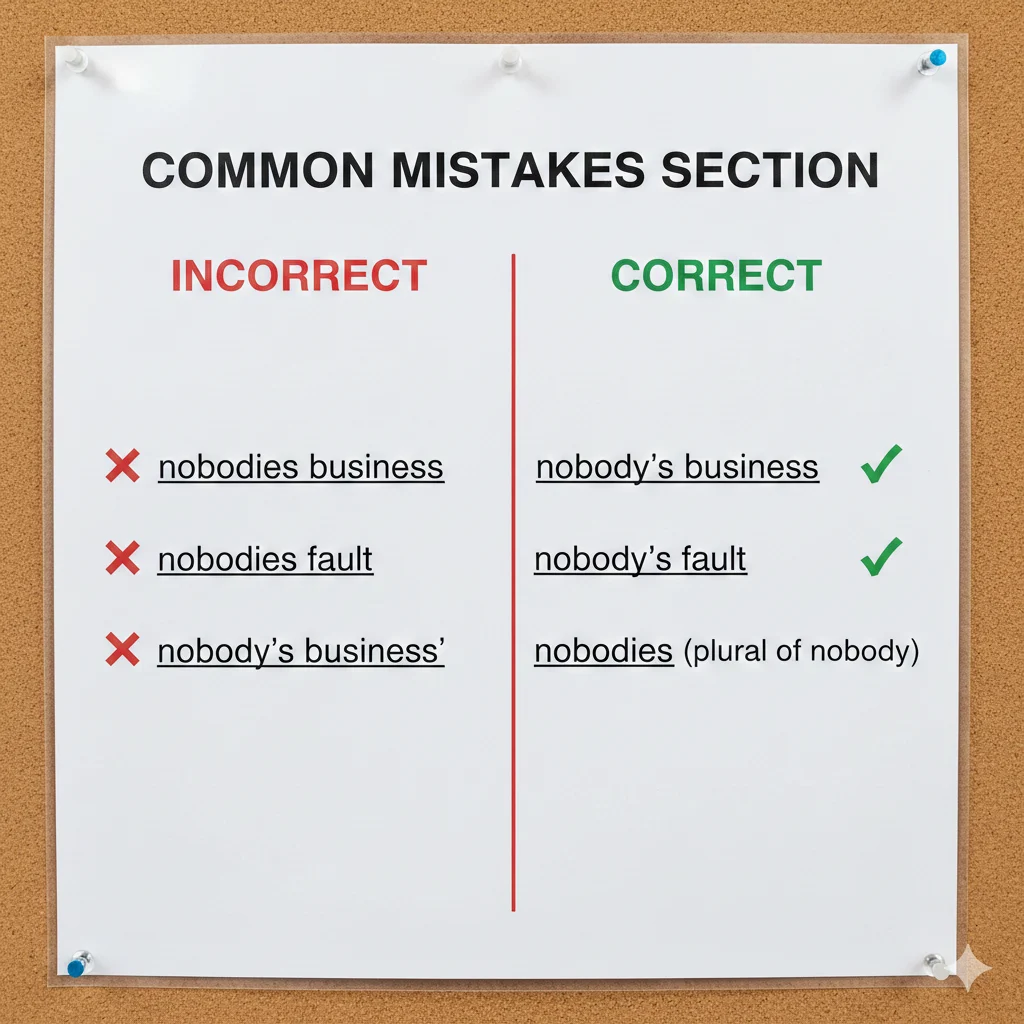
1️⃣ Apostrophe for plural
❌ Wrong: There were many nobody’s here
✅ Correct: There were many nobodies here
2️⃣ Missing apostrophe in contraction
❌ Wrong: Nobodys is coming
✅ Correct: Nobody’s coming
3️⃣ Singular vs plural verbs
- Nobody plural or singular? → Singular
✅ Correct: Nobody is late
❌ Wrong: Nobody are late
Related Pronoun Rules
- Anybody singular or plural? → Singular
- Everybody singular or plural? → Singular
- Somebody singular or plural? → Singular
- Everybody anybody somebody nobody singular or plural? → All singular
Examples:
- Everybody is ready.
- Anybody knows the answer?
- Somebody has called.
- Nobody is missing.
Nobodies vs Nobody’s in Everyday Examples
📧 Email Writing
- Nobody’s available today.
- They treated us like nobodies.
📰 News Headlines
- The band started as nobodies.
- Nobody’s comment was published.
📱 Social Media
- Nobodies talking about this trend!
- Nobody’s perfect ❤️
📄 Formal Writing
- The author describes minor characters as social nobodies.
- Nobody’s response met the required standards.
Google Trends & Usage Data 2026
According to Google Trends 2026, searches show:
- “Nobody’s perfect” → very high volume
- “Is nobodies a word?” → common ESL question
- “Difference between nobodies and nobody’s” → popular among students
Top countries:
- United States, United Kingdom, India, Pakistan, Canada
Audience: Students, writers, bloggers, ESL learners
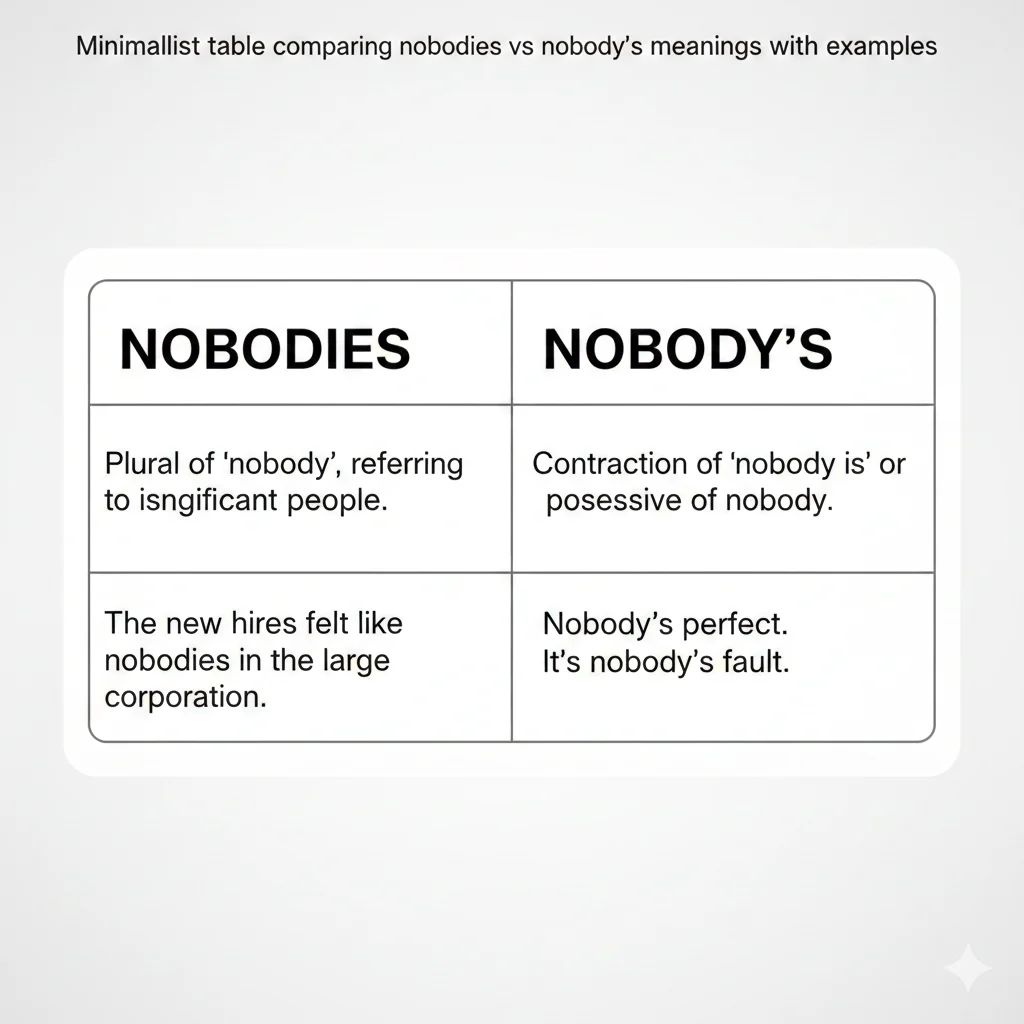
Comparison Table: Nobodies vs Nobody’s
| Word | Type | Meaning | Example |
|---|---|---|---|
| Nobodies | Plural noun | Many unimportant people | They were nobodies before success. |
| Nobody’s | Contraction | Nobody is/nobody has | Nobody’s perfect. |
| Nobody’s | Possessive | Belonging to nobody | That mistake is nobody’s. |
Related Grammar: Composed vs Comprised
| Term | Meaning | Example |
|---|---|---|
| Composed of | Made up of parts | The committee is composed of five members. |
| Comprises | Contains/includes parts | The committee comprises five members. |
✅ Tip: Whole comprises parts; Whole is composed of parts. Avoid “comprised of.”
FAQs
- Is nobodies a word?
Yes, it is the plural form of nobody. - Is “nobody’s” grammatically correct?
Yes, as contraction or possessive. - What’s the difference between nobody’s and nobodies?
Nobodies = plural noun; Nobody’s = contraction or possessive. - Nobody plural or singular?
Singular. - When to use nobodies?
For more than one unimportant or unknown person. - How do you spell nobody’s?
Add apostrophe + s → nobody’s. - Nobodies or nobody’s perfect?
Correct: Nobody’s perfect.
Conclusion
The difference between nobodies vs nobody’s is simple but important. Nobodies refers to multiple unimportant or unknown people, while nobody’s is either a contraction (nobody is/nobody has) or possessive form. Misplacing an apostrophe can change meaning completely.
Remember:
- Nobodies → plural noun
- Nobody’s → contraction or possessive
- Pronouns like everybody, anybody, somebody, nobody are singular
- Always check context before writing
With this guide, you’ll never confuse nobodies vs nobody’s again, and your writing will be professional, readable

Ann Quin is a content writer at Pray Ocean, sharing clear English word meanings and heartfelt prayers to guide and inspire readers worldwide.