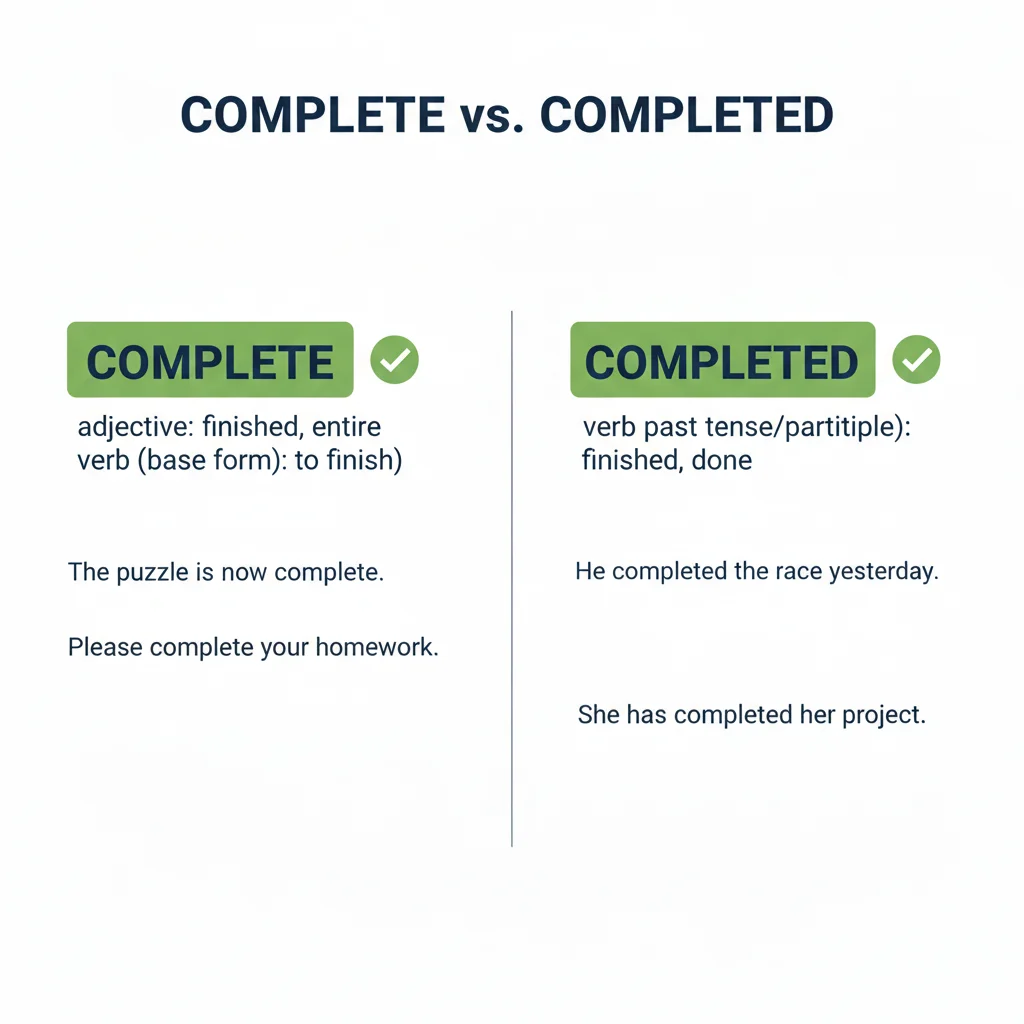
Complete means something is whole, finished, or lacking nothing.
Completed means the action of finishing has already happened.
Examples:
- The form is complete. (adjective: state)
- The team completed the project yesterday. (verb: past action)
👉 In short: complete = state, completed = action finished.
Many people search for complete vs completed because these two words look similar but work differently in real sentences. You may wonder: Is it “job complete” or “job completed”? Should I say “the task is complete” or “the task is completed”? This confusion shows up in emails, reports, project updates, exams, and even social media posts. A small grammar mistake can make writing sound unclear or unprofessional. That’s why learners, professionals, and students often ask about complete vs completed grammar, examples, and correct usage.
This article solves that confusion in simple English. You’ll get a quick answer, clear rules, real-life examples, tables, FAQs, and professional advice. By the end, you’ll confidently know when to use complete and when completed is the better choice—without overthinking it.
The Origin of Complete vs Completed
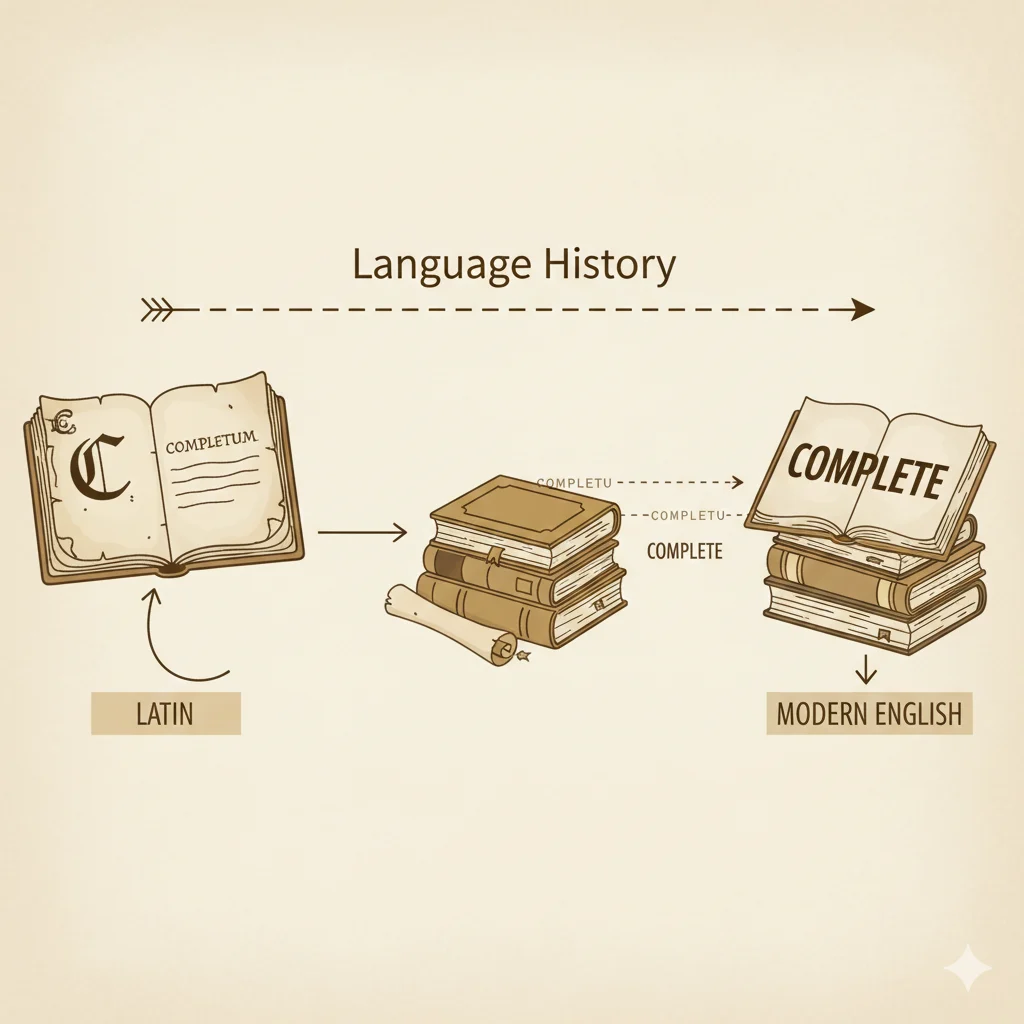
The word complete comes from the Latin completus, meaning “filled up” or “finished.” Over time, English kept complete as an adjective and verb.
Completed developed as the past tense and past participle form of the verb complete.
There is no spelling difference between British and American English for these words. The confusion exists because English uses one word in multiple grammatical roles.
- Complete can be an adjective (a complete task) or a verb (to complete work).
- Completed is always tied to past action.
So the issue is grammar, not spelling or region.
British English vs American English Spelling
There is no spelling difference between British and American English for complete and completed.
Comparison Table
| Aspect | British English | American English |
|---|---|---|
| Complete | complete | complete |
| Completed | completed | completed |
| Meaning | Same | Same |
| Usage rules | Same | Same |
✅ Unlike colour/color, complete vs completed stays the same worldwide.
Possess vs Posess: This One-Letter Error Costs Marks ⚠️
Which Spelling Should You Use?
Since spelling does not change, your choice depends on context and audience.
- US audience: Follow grammar rules. Use complete for status, completed for past actions.
- UK/Commonwealth: Same rules apply.
- Global or ESL audience: Prefer simple sentence structure like “The task is complete.”
👉 Choose based on meaning, not location.
Common Mistakes with Complete vs Completed
Here are frequent errors and fixes:
- ❌ The project has complete.
✅ The project is complete. - ❌ The task complete yesterday.
✅ The task was completed yesterday. - ❌ Job completed status.
✅ Job complete status or Job has been completed. - ❌ The form is completed by me.
✅ I completed the form.
Complete vs Completed in Everyday Examples
Emails
- Your application is complete.
- We have completed the review.
News
- The bridge is now complete.
- Engineers completed construction last night.
Social Media
- Workout complete 💪
- I finally completed my course!
Formal Writing
- The report is complete and ready.
- The team completed all assigned tasks.
M’am vs Ma’am: The Hidden Truth Behind This Confusion 👀
Complete vs Completed – Grammar Explained
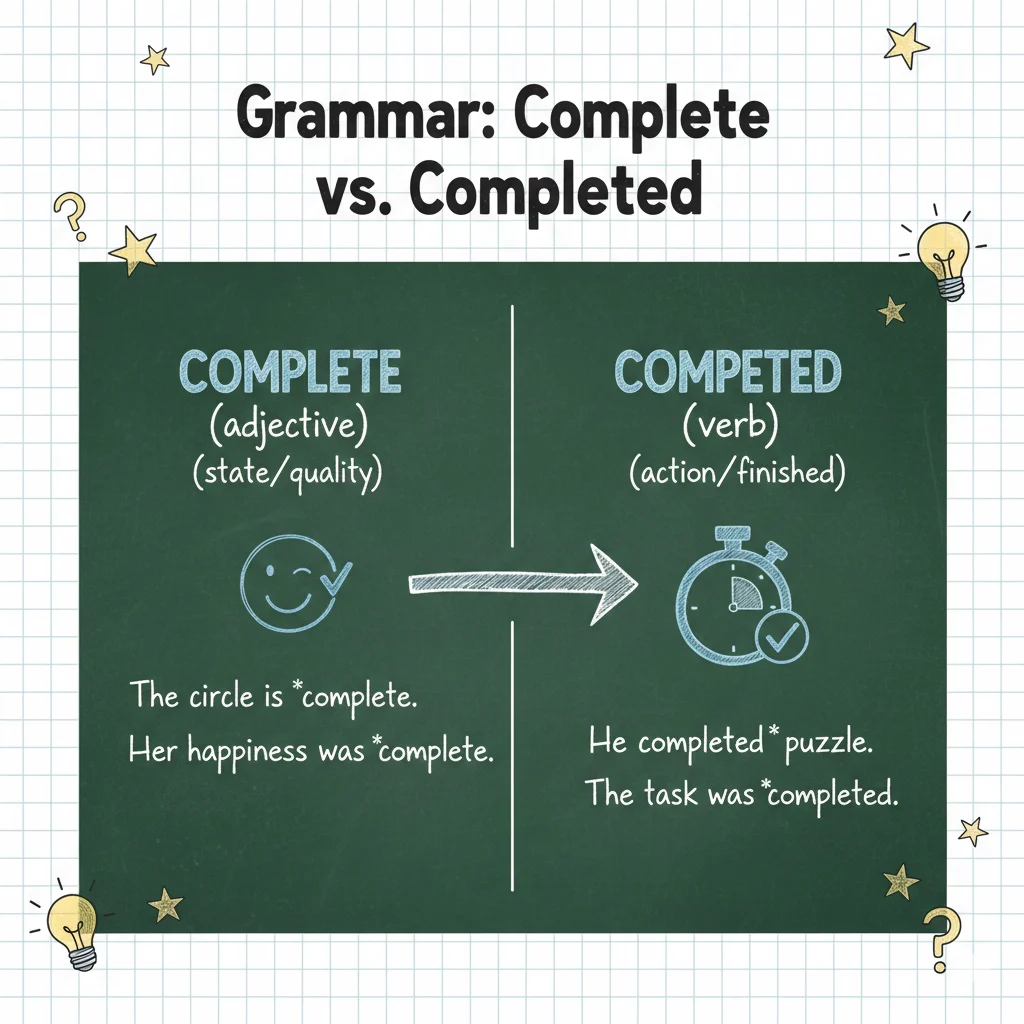
Complete (Adjective)
- Shows status or condition
- The task is complete.
- A complete solution
Completed (Verb / Past Participle)
- Shows action finished
- She completed the assignment.
- The project has been completed.
👉 This solves complete vs completed adjective confusion.
Special Sentence Confusions Explained
- Project is complete or completed?
✔ Project is complete (status)
✔ Project has been completed (action) - The task is complete or completed?
✔ The task is complete (preferred) - Job complete or job completed?
✔ Job complete (headline/status)
✔ Job completed (action-focused) - Complete or completed status?
✔ Complete status (more natural)
Complete vs Completed vs Finish
People also ask: What is the difference between finish and complete?
- Finish: End an activity
- Complete: Make something whole
Examples:
- I finished reading.
- I completed the course.
👉 Complete sounds more formal and professional.
Complete vs Compleat
Compleat is an archaic spelling.
It appears only in fixed phrases like “The Compleat Gentleman.”
❌ Do not use compleat in modern writing.
Complete vs Completed – Google Trends & Usage Data
- Complete is more popular in:
- Status updates
- Headlines
- UI labels (Task Complete)
- Completed is more common in:
- Reports
- Academic writing
- Past-tense explanations
Search interest is high in:
- United States
- United Kingdom
- India
- Pakistan
- Philippines
Context decides usage, not region.
Comparison Table: Complete vs Completed
| Feature | Complete | Completed |
|---|---|---|
| Part of speech | Adjective / Verb | Verb (past) |
| Shows status | Yes | No |
| Shows past action | No | Yes |
| Example | Task is complete | Task was completed |
| Common use | Labels, states | Reports, actions |
FAQs: Complete vs Completed
What is the difference between complete and completed?
Complete shows status. Completed shows finished action.
Is it “project is complete” or “project is completed”?
“Project is complete” is more natural.
Is it job complete or job completed?
Both are correct. Use job complete for status.
Is complete an adjective?
Yes, and it can also be a verb.
Is completed always past tense?
Yes, it refers to finished action.
Can I use complete in exams?
Yes, it’s formal and correct.
What is complete vs completed quiz answer?
Choose complete for state, completed for action.
Conclusion
Understanding complete vs completed is easier when you focus on meaning, not memorization. Complete describes a condition—something is whole, finished, and needs nothing more. Completed tells us that an action happened in the past and has ended. This simple difference answers common questions like “The task is complete or completed?” and “Project is complete or completed?” In professional writing, status updates, and UI labels, complete sounds cleaner and more natural. In reports, explanations, and timelines, completed fits better. There is no British or American spelling difference, so writers worldwide follow the same rule. Avoid outdated spellings like compleat, and don’t confuse finish with complete. If you remember one rule, remember this: use complete for state, completed for action. Mastering this small grammar point instantly improves clarity, confidence, and professionalism in everyday English.

Vera Brittain is a writer at Pray Ocean, providing clear English word meanings and inspiring prayer content for everyday readers.